

The retail real estate market has changed more in the past five years than in the previous twenty. If you’re still using pre-pandemic playbooks, you’re already behind. The question isn’t whether retail is viable anymore. It’s about which commercial real estate investment strategies match current market conditions and which are burning capital.
This guide walks through the four main retail real estate investment strategies, how they perform in 2026, and what you need to evaluate before committing capital.
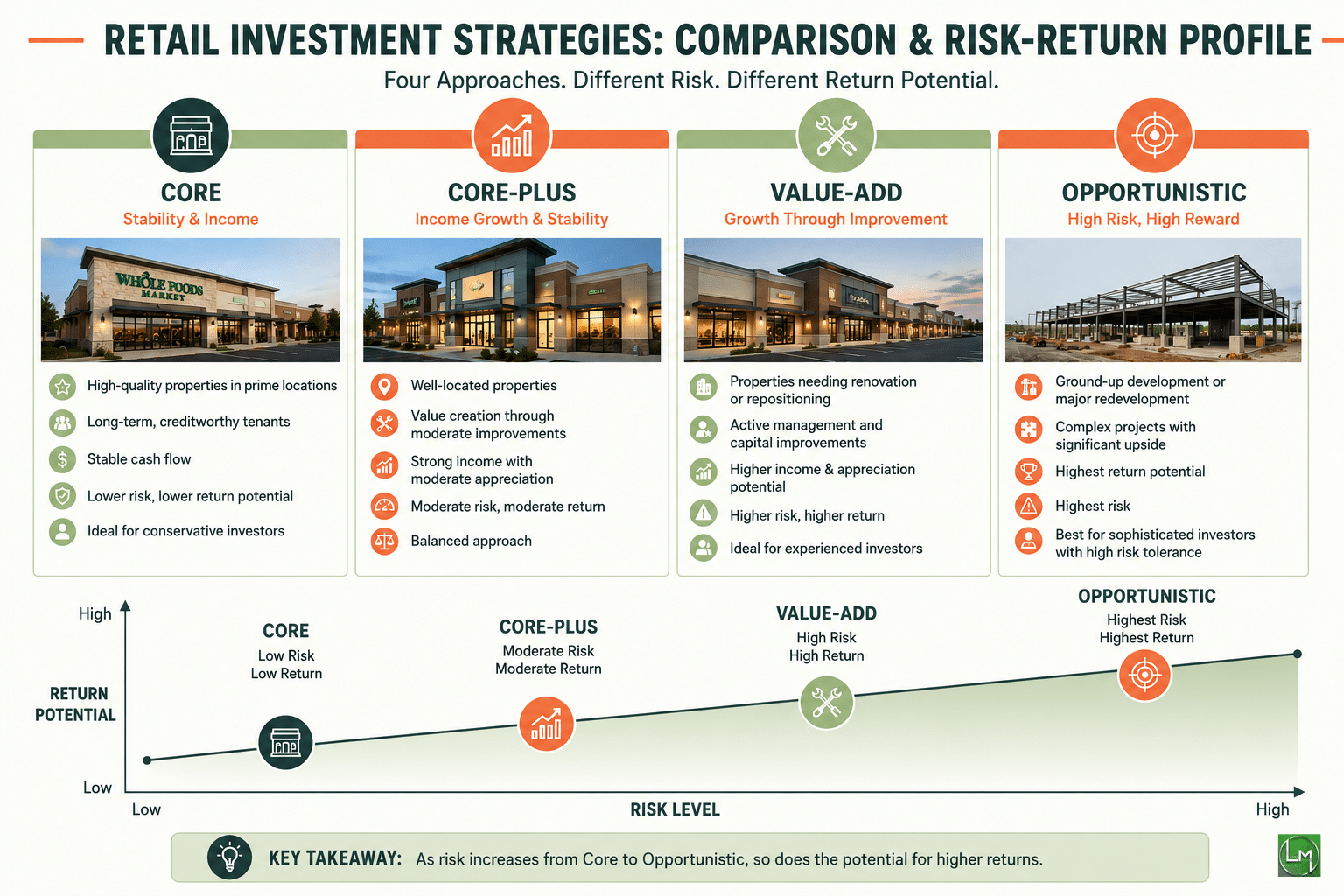
Core retail real estate investment strategy
Core investments target stabilized properties in strong markets with high occupancy and creditworthy tenants. These are grocery‑anchored centers, necessity‑based retail, and properties in dense, affluent areas with proven foot traffic.
The appeal is predictable cash flow and capital preservation, typically delivering 5–7% annual returns. Risk is low because the properties are already performing and located in markets with stable demand.
Core retail works best for institutional investors, REITs, and individuals prioritizing income generation over aggressive growth. The downside is limited upside, with competition from institutional capital driving up pricing and compressing cap rates.
Core-plus retail real estate investment strategy
Core‑plus investments sit between core and value‑add. These properties have strong fundamentals but need light repositioning, lease‑up, or tenant mix adjustments to reach full stabilization.
Examples include shopping centers with 85% occupancy needing anchor tenants or properties with below‑market rents that can be raised. Expected returns range from 8–10% annually, with moderate risk tied to execution.
This strategy suits investors seeking higher returns than core but not full value‑add risk. You’re still buying in good locations with established traffic patterns, but execution determines yield.
Value-add retail real estate investment strategy
Value‑add investments target underperforming properties with clear paths to improvement in high vacancy, deferred maintenance, poor tenant mix, or outdated design.
Returns typically range from 12-15% annually if repositioning succeeds. Risk is higher because success depends on execution. These proven property acquisition methods can help identify undervalued opportunities.
Common plays include renovating tired centers, replacing weak tenants, adding pad sites, or converting underused space into restaurants or fitness concepts.
Value‑add requires hands-on management, construction oversight, leasing expertise, and capital reserves. The upside is meaningful: executed well, these deals can generate strong cash‑on‑cash returns and appreciation at exit.
Opportunistic retail real estate investment strategy
Opportunistic investments target distressed assets, ground‑up development, or major redevelopments. These carry the highest risk and aim for 15%+ annual returns.
Examples include failed malls needing conversion into mixed‑use or raw land in growth corridors for new retail.
This strategy requires deep expertise, significant capital, and tolerance for construction, entitlement, and market timing risks. For those exploring different paths, alternative land investment opportunities may offer lower barriers to entry.
The potential upside is substantial, but the failure rate is higher than any other strategy.
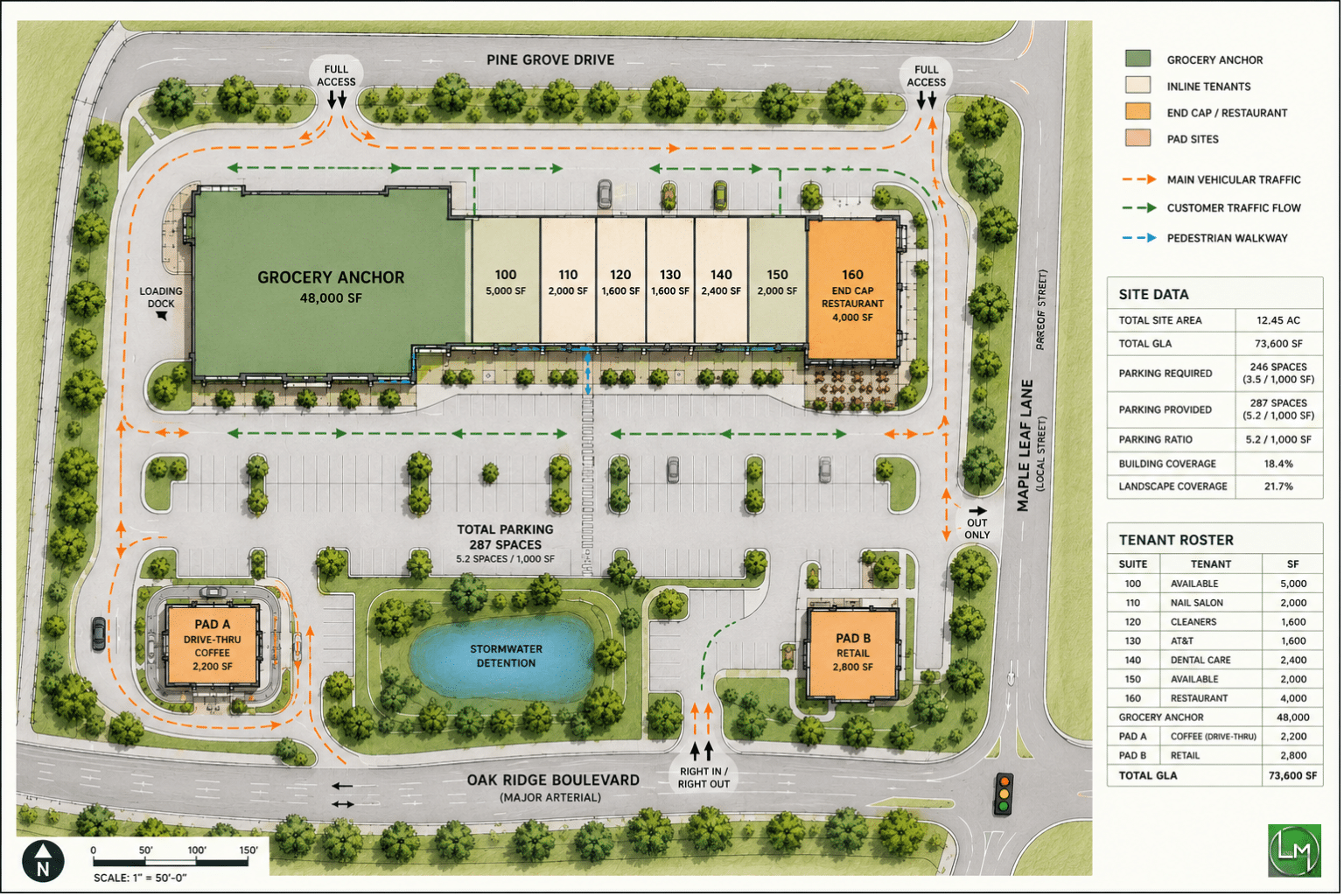
Retail property types and sector-specific considerations
Retail real estate includes multiple property types, each with different risk profiles and performance drivers.
Neighborhood and community centers are anchored by grocery stores, drugstores, or discount retailers. These properties serve daily needs and tend to be more resilient during economic downturns. Grocery-anchored centers are considered defensive assets because food shopping remains consistent regardless of e-commerce trends.
Power centers feature big-box retailers like home improvement stores, warehouse clubs, and category killers. These properties depend on strong anchor tenants and benefit from high traffic volumes.
Lifestyle centers combine retail, dining, and entertainment in walkable, open-air formats. These properties target higher-income consumers and emphasize experience over pure transactions.
Regional malls face the most pressure from e-commerce and changing consumer behavior. Many are struggling with anchor closures, declining foot traffic, and falling rents. Some are being repositioned into mixed-use developments with residential, office, and entertainment components.
Strip centers and single-tenant net lease properties offer simplicity and passive income. Single-tenant properties leased to creditworthy national tenants provide stable cash flow with minimal management.
Each property type responds differently to market conditions, demographics, and shifts in consumer behavior. Your commercial real estate investment approaches should align with the specific dynamics of the property type you’re targeting.
Market fundamentals and economic trends affecting retail
Retail property performance is driven by local economic conditions: population growth, household income, employment trends, and retail sales growth.
Demographics matter more than almost any other factor. Population growth drives demand for retail space. Household income determines spending power and the types of retailers that can succeed. Reviewing demographic and urbanization research helps investors understand these critical trends.
Employment trends influence retail spending. Markets with diversified job bases and growing employment tend to support stronger retail performance. Tracking employment and economic indicators provides insight into local market health.
Supply and demand dynamics determine rent growth and occupancy. Oversupplied markets face downward pressure, while undersupplied markets support rent growth. Undersupplied markets with strong demand support rent growth and low vacancy.
Interest rates and capital markets affect property values and financing costs. Rising rates increase debt costs and compress cap rates, reducing property values. In 2026, rates have stabilized but remain higher than the 2010s.
Consumer spending shifts with economic cycles: discretionary retail suffers in downturns, while necessity‑based retail holds up.
Geographic market selection and location analysis
Location drives retail success more than any other factor. The best property with the wrong location will underperform. A mediocre property in a strong location can still generate solid returns.
Start with metro-level analysis. Look for markets with population growth, job growth, rising incomes, and favorable business climates. Avoid markets with declining populations, weak job markets, or oversupplied retail inventory.
Narrow down to submarket analysis. Within strong metros, identify submarkets with high household incomes, dense populations, and limited competition. Traffic counts, visibility, and access matter.
Evaluate trade area demographics. Who lives and works within a 3-mile radius? What’s the average household income? What’s the population density? What retail options already exist?
Assess the competitive landscape. What other retail properties are nearby? Are they full or struggling? What tenants do they have? Consulting retail real estate industry benchmarks can provide valuable competitive context.
Consider future development. Is a new residential or commercial development planned nearby? Will that bring more customers or more competition?
Strong locations don’t guarantee success, but weak locations almost guarantee failure.
Consumer behavior shifts driving retail demand
Consumer behavior has fundamentally changed, and commercial real estate investment strategies must adapt.
E-commerce is permanent, but physical retail isn’t dead. Online shopping now accounts for roughly 15% of total retail sales. That’s significant, but it also means 85% of retail still happens in physical locations.
Experiential retail is growing. Consumers increasingly value experiences over pure transactions. Restaurants, fitness studios, entertainment venues, and service-based tenants are replacing traditional soft goods retailers.
Convenience drives foot traffic. Consumers want to shop close to home or work, with easy parking and quick access. Neighborhood centers and well-located strip centers benefit from this trend.
Omnichannel integration is now standard. Successful retailers use physical stores as fulfillment centers, pickup locations, and showrooms. Properties that can support these functions have competitive advantages.
Grocery and necessity-based retail remain resilient. People still need to buy food, prescriptions, and household essentials. Grocery-anchored centers continue to perform well because they generate consistent traffic regardless of economic conditions.
Understanding these shifts helps you evaluate which retail property types and tenant mixes will perform best going forward.
Investment volume trends and transaction activity
Retail investment volume dropped during the pandemic and has gradually recovered, though still below pre‑2020 peaks.
Capital flows selectively, favoring grocery‑anchored centers and necessity‑based retail. Regional malls and struggling centers see minimal activity, with most investment opportunistic and redevelopment‑focused.
Private equity and institutional investors dominate larger transactions, while individuals target smaller neighborhood centers and single‑tenant net lease properties.
Debt financing is tighter, with lenders requiring higher equity and scrutinizing cash flow more closely.
If you’re entering the market now, expect competition for the best assets and more conservative financing terms than you might have seen five years ago.
Adapting retail strategies to current 2026 market conditions
The retail real estate landscape in 2026 requires flexibility and a clear-eyed view of what’s working. Your approach needs to reflect current realities, not outdated assumptions.
Focus on necessity-based retail and grocery-anchored centers: resilient assets that attract tenants and investors.
Avoid regional malls unless you have deep redevelopment expertise and a credible conversion plan. Prioritize locations with strong demographics and limited new supply. Underwrite conservatively using realistic rent assumptions.
Prioritize locations with strong demographics and limited new supply. Population growth, rising incomes, and undersupplied markets give you tailwinds. Thorough due diligence on market data helps identify the best investment opportunity in each metro area.
Underwrite conservatively. Use realistic rent assumptions based on recent comparable leases, not pro forma projections. Understanding whether land investing offers better risk-adjusted returns can provide perspective on alternative strategies.
Plan for active management. Retail properties require leasing, tenant relations, maintenance, and ongoing repositioning. Stabilized properties still need attention to maintain performance.
Consider mixed-use and adaptive reuse opportunities. Some of the best plays in 2026 involve converting underused retail space into mixed-use developments with residential, office, or entertainment components.
The investors who succeed in retail real estate over the next few years will be those who adapt to current conditions rather than fighting them. Analyzing market data and identifying each investment opportunity with proper due diligence separates successful core-plus investments from failed ventures.
Most retail real estate investors focus on big commercial deals, but land investing offers a practical entry point with lower capital requirements and faster deal cycles. At The Land Method, we teach multiple strategies based on what’s working right now in real markets, with conservative numbers and real-world due diligence. If you want to build a diversified portfolio through direct ownership, get in touch with our team to see how active investors are building deal flow and closing transactions in 2026. You can also explore our free land investing training to get started.

FAQs
Q1. What does a retail real estate investment strategy involve?
A1.
It defines your target property type, risk tolerance, return expectations, and how you’ll create value through property selection, management, or repositioning.
Q2. How is retail different from office or industrial real estate?
A2.
Retail depends on consumer traffic and location visibility, office on employment trends, and industrial on logistics demand. Retail leases are often shorter and more sensitive to cycles.
Q3. Is retail real estate still worth investing in after the e-commerce shift?
A3.
Yes – focus on e‑commerce‑resistant assets like grocery‑anchored centers, necessity‑based retail, and experiential formats in strong demographics.
Q4. What are the safest strategies for beginners?
A4.
Core investments in grocery‑anchored neighborhood centers in growing markets offer the lowest risk profile.
Q5. What is the 7% rule in real estate investing?
A5.
A benchmark suggesting annual appreciation plus cash flow should total at least 7%. It’s a guideline, not a replacement for full financial analysis.
Q6. What risks can derail a retail investment?
A6.
Tenant bankruptcies, anchor closures, oversupply, demographic shifts, rising interest rates, construction overruns, and prolonged lease‑up periods.
Q7. How do I know if a retail property is priced below replacement cost?
A7.
Compare the purchase price to the cost of building a similar property today (land, construction, soft costs, financing). A lower price in a strong location may offer downside protection.

Ginis Garcia is a seasoned real estate investor with over 14 years of experience helping both new and experienced investors achieve their goals in the housing and land markets. He started doing deals here and there in 2008. In 2011, He started working for a major real estate investor. He got his real estate license in 2012.