

There isn’t one fixed formula for real estate investing. Different real estate investment strategies make sense in different market conditions, and they depend heavily on your financial goals, capital requirements, and risk tolerance.
Before you buy any investment property, the question isn’t complicated:
Will this property produce consistent cash flow after property taxes, operating expenses, financing costs, and realistic vacancy rates?
That’s where most deals either stand up or quietly fall apart.
In the current real estate market, performance is shaped by a few moving parts:
- Interest rate direction and policy decisions from the Federal Reserve
- Local home prices and verified property values based on closed sales
- Rental demand and the reliability of the income stream
- Market volatility and tightening or loosening financing options
Residential real estate, particularly single-family homes, can generate steady income when the purchase price is disciplined, and rent collection is consistent. Commercial properties, such as office buildings or apartment complexes, may offer stronger capital appreciation, but they also entail higher risk and greater capital requirements.
For investors who prefer less operational involvement, there are indirect investment options:
- Real Estate Investment Trusts and traded REITs listed on stock exchanges
- Exposure through mutual funds
- Participation in a real estate investment group
These reduce hands-on management of physical properties, but they don’t remove risk. Management fees, taxable income, and broader Tax Implications still influence overall investment returns.
At The Land Method, strategies are tested against real market research and conservative assumptions. Whether it’s buy-and-hold, value-add, land investing, or portfolio diversification, the numbers must work under normal conditions, not just optimistic ones. While this guide covers real estate broadly, land remains a distinct and increasingly relevant strategy within that landscape due to its simplicity and flexibility.
Introduction to Real Estate Investing Strategies

Why Real Estate is a Key Investment Option
Investors are drawn to real estate for one main reason: control.
When you own an investment property, you influence pricing, rent collection, expense management, and exit timing. That’s very different from holding mutual funds or trading on stock exchanges, where decisions happen outside your control. In the real estate industry, outcomes are closely tied to execution.
Why do many investors treat it as a core investment option:
- Cash flow is measurable monthly
- Property values respond to local demand, not just headlines
- Tax benefits, including tax deductions and potential tax savings, can reduce the overall tax bill
- It adds portfolio diversification beyond traditional paper assets
Understanding property types is critical. Residential real estate, including single-family homes, behaves differently from commercial properties such as office buildings or apartment complexes. Operating expenses, vacancy rates, and capital requirements vary significantly. So does the level of risk tolerance required.
Your financial goals should guide investment decisions. A long-term investment built around steady income looks very different from a value-add strategy focused on capital appreciation. Your financial situation and investment horizon set the limits, not social media trends.
Market Trends and the Importance of Market Research
The real estate market doesn’t always shift loudly. Often, changes show up first in smaller signals: longer days on market, softening rent growth, and subtle changes in financing options.
Home prices adjust. Rental demand tightens or eases. When the Federal Reserve shifts rates, borrowing costs move quickly. Market conditions can change faster than many investors anticipate.
Before entering any deal, step back and review:
- Verified property values from recent closed transactions
- Current vacancy rates and achievable rent levels
- Sensitivity to market volatility
- Comparable properties within the same submarket
Solid market research isn’t optional. It’s basic due diligence. Run projections under conservative assumptions. Question the purchase price. Stress-test the numbers if rents stall or financing costs increase. Real estate investing strategies only hold up when they survive average conditions, not perfect ones.
Core Real Estate Investment Strategies
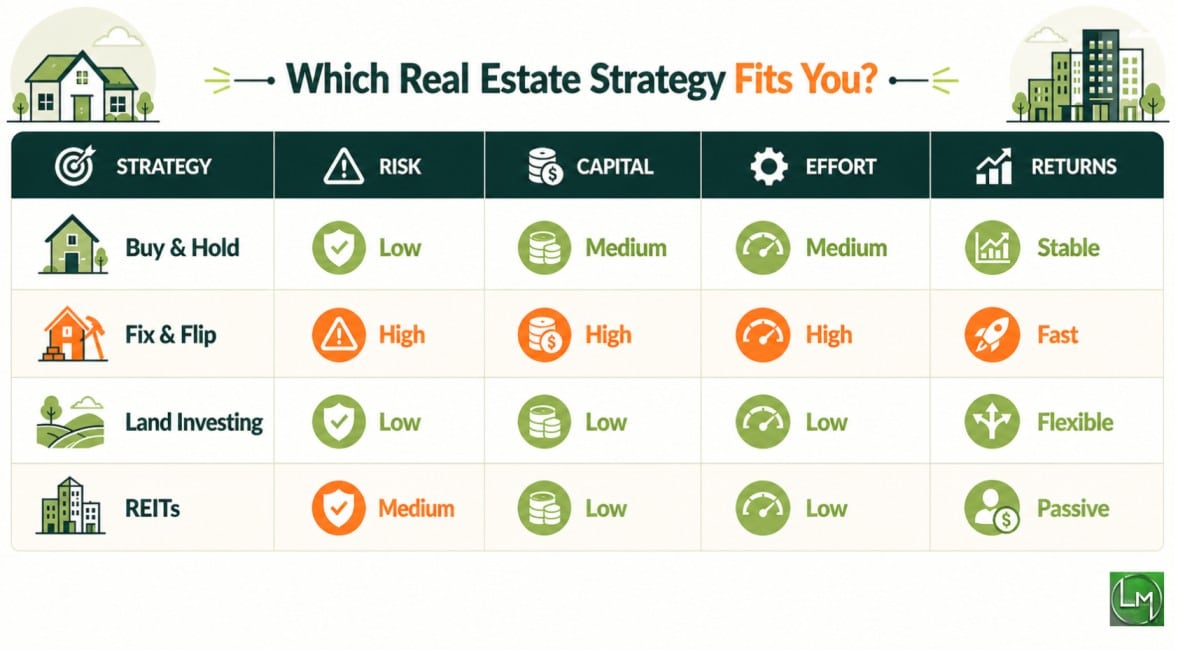
There’s no universal “best” strategy in real estate. What works depends on time, available capital, and risk tolerance. Some strategies slash the operational complexity, for instance, land investing, while, on the other hand, in the case of rentals or commercial assets, the focus is put more than heavily on ongoing income and management.
Buy and Hold for Long-Term Wealth
Buy and hold sounds straightforward: acquire an investment property and retain it for an extended period. But it only works when the deal makes sense from the beginning.
Many investors start with residential real estate, such as single-family homes. The objective is simple: steady cash flow after property taxes, insurance, maintenance, and operating expenses. When rent collection consistently exceeds costs, the asset can support itself while property values gradually appreciate.
Common mistakes include:
- Overpaying at purchase
- Underestimating vacancy rates
- Assuming rents will automatically increase
When structured properly, this long-term investment can build an income stream that strengthens an overall investment portfolio.
Fix and Flip or Value-Add Strategy
The value-add approach is more active. Investors purchase distressed properties below market value, improve them, and aim to sell at a higher price. Some attempt a live-in flip to reduce holding costs.
Margins depend on disciplined math:
- A clear gap between purchase price and realistic resale value
- Accurate renovation budgets
- Time buffers for delays
Hard money loans can speed transactions but increase pressure. If market value softens or timelines extend, returns shrink quickly. While capital appreciation can be strong, this strategy carries higher risks.
Short-Term Rentals and House Hacking
Short-term rentals may outperform traditional leases in certain locations, but income can fluctuate with seasonality and regulation.
Key considerations include:
- Local regulations
- Consistent rental demand
- Sensible financing to manage mortgage payments
House hacking allows property owners to live in one unit while renting others. It reduces personal housing costs and builds equity, but it still requires active management and clear lease agreement terms.
Each real estate strategy fits a different stage of an investment journey. The choice should reflect financial goals and capital capacity, not momentum or headlines.
Land Investing as a Low-Barrier Strategy
Investing in land is, in fact, an entirely new avenue with many changes from the way traditional real estate assets are viewed, such as residential or commercial properties. In comparison with rental properties, the day-to-day responsibilities of owners of land are virtually nil: no tenants, no renovations, and hardly any management at all.
This actually gives many investors, particularly those who are new in this field, a less complicated way into real estate. Besides, the deals are usually pretty easy to understand, the holding costs are less, and the fact that the deal does not depend on rental income can make it more attractive.
In fact, a very salient feature of land investing is the fact that marketing is the main factor of getting new deals. In other words, instead of simply hanging on to property appreciation, investors also put out their feelers for opportunities at a discount and then make the most of them through positioning and resale.
Because of this structure:
- Capital requirements can be significantly lower
- Operational complexity is reduced
- Timelines can be shorter compared to traditional property investments
Within a broader real estate portfolio, land can serve as a flexible, lower-risk entry strategy or as a complementary approach alongside more traditional income-producing assets.
Exploring Commercial Real Estate Opportunities
Investing in Commercial Properties
Commercial real estate often appears attractive because of scale. Larger buildings. Larger leases. Larger numbers. But at its core, it’s an operating business.
Office buildings, shopping centers, apartment buildings, and apartment complexes are valued primarily on income performance. If cash flow weakens, property values adjust quickly.
Before entering a commercial deal, review:
- Cap Rate based on actual collected income
- Lease strength and remaining term
- Vacancy exposure
- Operating expenses and oversight
- Tax Implications, including capital gains tax at exit
Commercial properties involve higher capital requirements and higher risks. Financing options are stricter, and lenders scrutinize income stability. A short period of weak occupancy can materially affect returns. Here, due diligence isn’t optional.
Real Estate Projects in Prime Locations
Prime real estate projects in high-demand cities like New York offer strong rental demand, stable tenants, and consistent property appreciation. While the purchase price may be higher, these locations often deliver reliable long-term returns and steady income, making them attractive for serious investors.
To maximize results, investors must focus on market analysis and efficient property management. Evaluating market trends, vacancy rates, and growth potential, along with hiring a reliable property management company, can significantly improve rental income, reduce operating costs, and enhance overall returns.
Alternative Real Estate Investing Options
Not every investor wants direct responsibility for physical properties. The real estate industry offers exposure without daily tenant management.
Real Estate Investment Trusts (REITs) and Traded REITs
Real Estate Investment Trusts own income-producing commercial properties and distribute earnings to investors. Traded REITs are listed on stock exchanges, offering liquidity.
Before allocating capital, examine:
- Cash flow stability across market cycles
- Impact of management fees
- Treatment of taxable income and overall Tax Implications
- Exposure to market volatility
Some investors hold traded REITs in retirement accounts for tax efficiency. Others access them through mutual funds as part of portfolio diversification. Liquidity is convenient, but pricing can move with equity markets.
Real Estate Crowdfunding Platforms
Real estate crowdfunding allows investors to participate in larger real estate projects with smaller capital commitments.
Before investing, evaluate:
- The sponsor’s track record
- Capital requirements and lock-in periods
- Assumptions behind projected returns
- Exposure to higher risks if leasing or construction slows
Even in pooled structures, disciplined underwriting remains essential.
Final Thoughts on Real Estate Investment Strategies
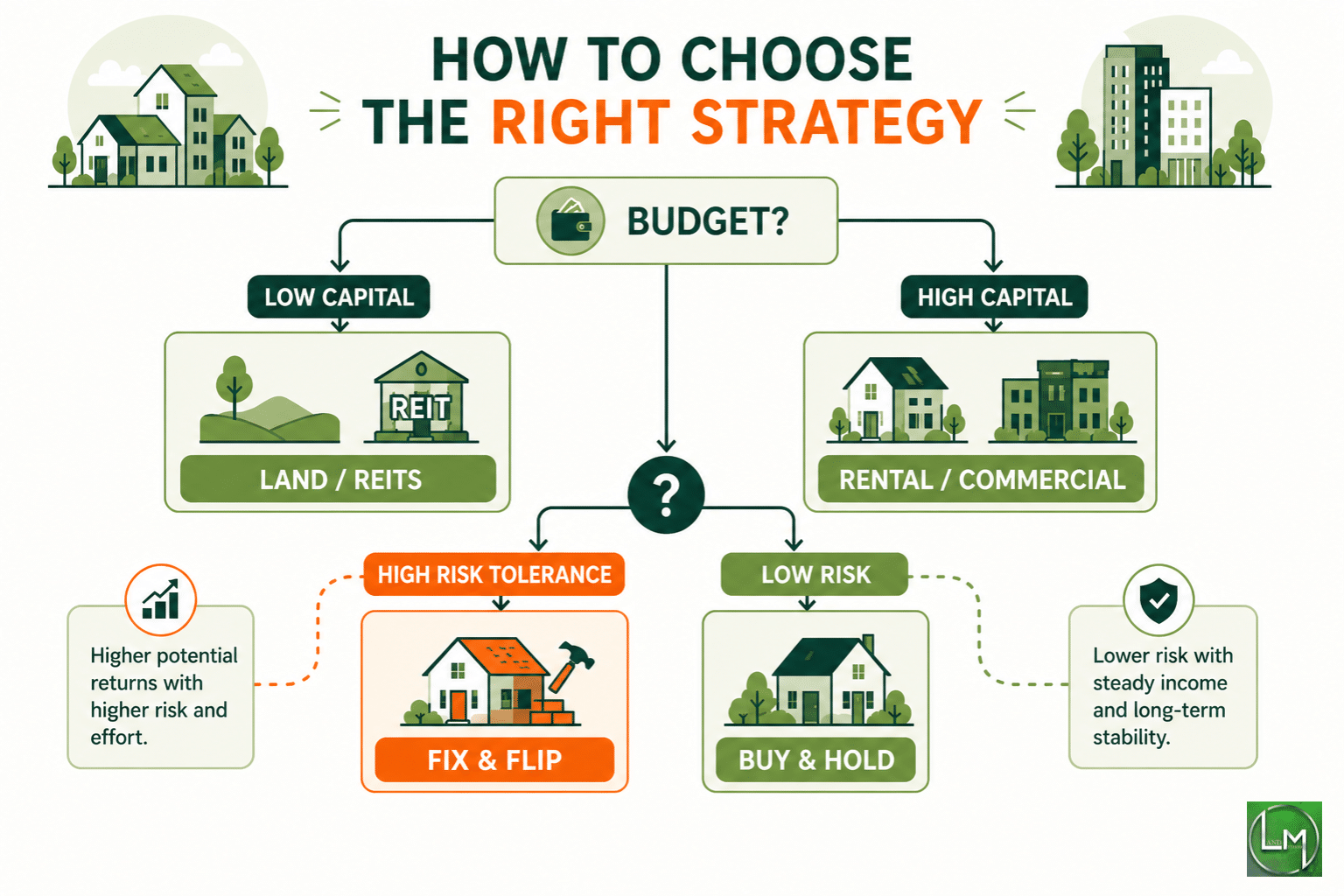
Every investor approaches real estate with a different financial situation. Some prioritize steady income. Others focus on capital appreciation. Many combine real estate with retirement accounts, mutual funds, or other investment options.
Before committing to any investment property, review the fundamentals:
- Does the asset produce reliable cash flow after property taxes and operating expenses?
- Are financing options sustainable if rates shift?
- How exposed is the property to vacancy rates or market volatility?
- What are the Tax Implications, including capital gains tax?
Sound real estate strategies are grounded in due diligence and realistic projections. Whether investing in residential real estate, commercial properties, traded REITs, or a real estate investment group, long-term investment returns depend on discipline.
How The Land Method Supports Your Investment Journey
The Land Method does not rely on trend-driven investment decisions. The approach centers on structure, risk awareness, and alignment.
In practice, that means:
- Matching acquisitions with clearly defined financial goals
- Assessing risk tolerance before selecting property types
- Stress-testing projections using conservative assumptions
- Reviewing capital requirements and financing structure carefully
- Planning exit timing before capital is committed
Real estate assets are treated as operating businesses. Income, leverage, and downside exposure are evaluated before projecting upside.
Within this framework, land investing is approached as a streamlined acquisition and disposition model, where marketing efficiency, deal structure, and timing play a central role rather than ongoing property management.
Real estate can strengthen an investment portfolio when decisions are measured and grounded in analysis. With disciplined underwriting and experienced guidance, the investment journey becomes deliberate rather than reactive.

FAQs
Q1. Which real estate strategy is easiest for beginners?
A1. Land investing is often the easiest starting point due to fewer moving parts, lower capital needs, and no ongoing property management.
Q2. How do interest rate changes affect my investment?
A2. Higher rates increase mortgage costs and can reduce net rental income.
Q3. Should I choose REITs or direct property ownership?
A3. REITs are simple and liquid; direct property gives hands-on control and long-term growth potential.
Q4. Is land a good addition to a real estate portfolio?
A4. Yes, land can add flexibility and lower-risk exposure, especially as a low-maintenance or entry-level strategy.

Ginis Garcia is a seasoned real estate investor with over 14 years of experience helping both new and experienced investors achieve their goals in the housing and land markets. He started doing deals here and there in 2008. In 2011, He started working for a major real estate investor. He got his real estate license in 2012.