

The real estate talk in 2026 would not be confined to “purchasing a property and sitting idle”. Investors will focus on the property’s actual performance, the source of cash, the financial re-adjustment capacity, and exit scenarios in the event of a market change.
Data from recent U.S. housing reports show that investors still account for a large share of purchases in growth areas, especially where rental demand and migration are strong. That tells you one thing: serious capital still sees property as a long-term hedge against inflation and stock market swings.
Understanding Real Estate Investment Strategies
What Are Real Estate Investment Strategies?
Real estate investment strategies are well-planned methods for making money from real estate. They are aimed at increasing earnings, taking into account risk appetite, time frame, and the real estate market.
In 2026, investors are focusing on:
- Building multiple income streams through rental income
- Combining short-term gains with long-term investment growth
- Adapting to market volatility and shifting market trends
A well-defined strategy helps you move beyond guesswork and make calculated investment decisions in the real estate industry.
Real Estate vs. Stock Market: Key Differences
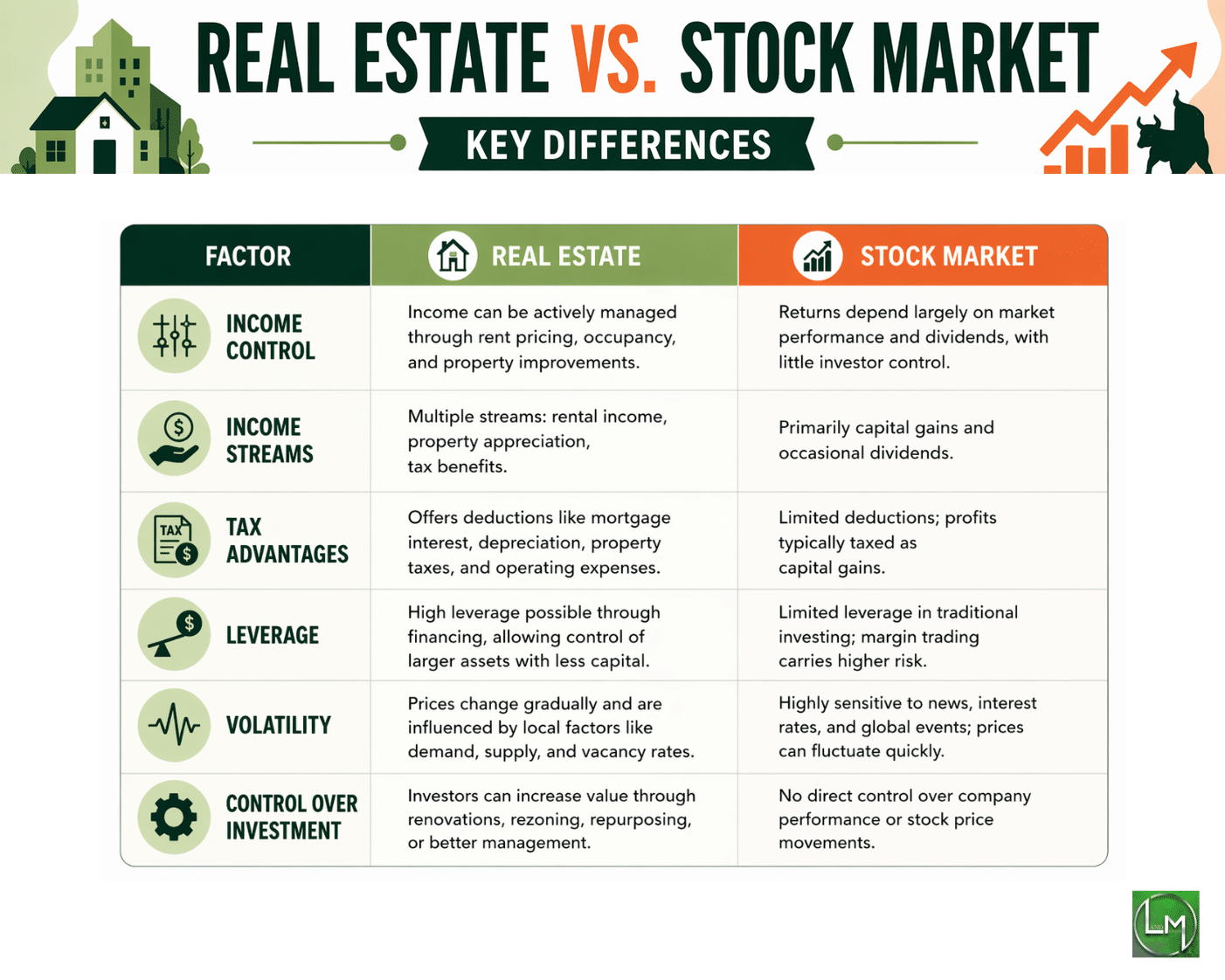
Both can build wealth, but they behave very differently once your money is in.
- Income is controllable in real estate.
An investment property can generate rental income, appreciate, and provide multiple income streams. Stocks and mutual funds depend mostly on market movements you can’t influence. - The tax side is stronger with property.
Mortgage interest, depreciation, operating expenses, and property taxes can all reduce taxable income. Stock profits usually mean capital gains with fewer deductions. - Leverage works differently.
Financing lets investors control a higher-value residential, multifamily, or commercial property while benefiting from rising property values. You rarely get that level of leverage in traditional stock investments. - Volatility plays out more slowly.
The share market is very sensitive to any publication of news or any change in interest rate. Property prices will not change overnight but they are mainly affected by local factors such as the amount of housing available, rental demand, and vacancy rates. - You can influence the outcome.
Real estate can be made more valuable by, for example, renovating, rezoning, repurposing, or better managing the property. On the other hand, stocks do not offer you that kind of control.
Types of Real Estate Investments to Explore
Residential, Commercial, and Mixed-Use Properties
Choosing the right kind of property is very important for your success. Residential properties primarily consist of single-family homes and multifamily properties, such as apartment buildings, which provide stable rental income. Meanwhile, commercial properties such as office buildings and shopping centers generally offer higher yields but also pose greater risks.
Meanwhile, mixed-use properties combine residential and commercial components, thus offering a variety of income sources.
For instance, purchasing an apartment building in an expanding city such as New York or in a new property market is likely to yield substantial capital gains.
These days, investors are more and more interested in different types of investments, for example:
- Real estate crowdfunding, which opens the possibility for smaller investors to participate in large real estate developments.
- Real estate syndication is a method of combining the money of several investors to buy expensive properties of high value
These approaches:
- Provide access to the secondary market
- Enable opportunistic strategies
- Reduce individual financial burden
They are especially useful for investors who want exposure to real estate without directly managing an investment property.
Key Factors to Consider Before Investing
Most bad real estate deals don’t happen because the market crashed. They happen because the investor didn’t look at the basics before buying. In 2026, with shifting interest rates and unpredictable market conditions, the smartest move is still the simplest: know your numbers and know your market.
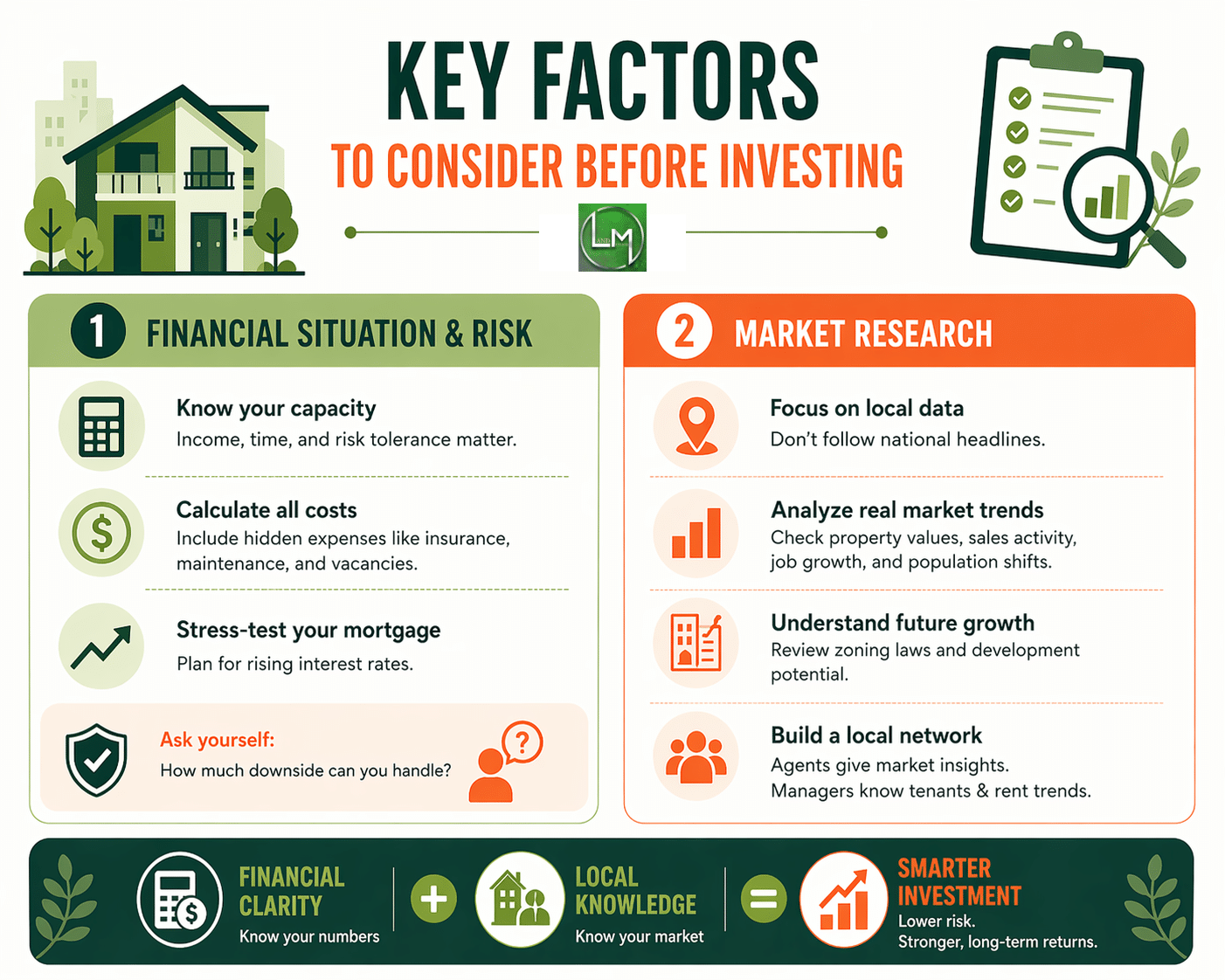
Understanding Financial Situation and Risk Tolerance
Before you even start looking at an investment property, look at your own situation first. A deal that works for someone else may not work for you. Your income, time, and comfort with uncertainty matter more than the deal itself.
Start by running realistic numbers, not optimistic ones:
- Break down all operating costs and ongoing operating expenses
- Include hidden holding costs like insurance, maintenance, and vacancies
- Stress-test your mortgage payments if interest rates rise
- Compare the purchase price with conservative rental income, not best-case scenarios
Many new investors underestimate how quickly small expenses eat into profits. A property that looks strong on paper can struggle if vacancy rates increase or property taxes go up. Local rental demand is often the biggest driver of long-term success, so it’s worth spending time here.
It also helps to step back and ask one simple question: how much downside can you handle? That’s your real risk tolerance. Some investors want stable, predictable cash flow. Others are comfortable with more uncertainty for higher upside.
Talking with a trusted financial advisor or experienced Real Estate Professional can bring a different perspective. Good investment advice isn’t about finding the perfect deal. It’s about choosing a long-term investment you can actually hold through changing cycles.
Conducting Thorough Market Research
Strong market research is rarely complicated. It just requires patience. Instead of chasing headlines about the national real estate market, experienced investors focus on small, local details.
They look at:
- Real property values, not asking prices
- Sales activity and past performance in specific neighborhoods
- Job growth, population shifts, and real market trends
The next layer is regulation and future growth. Understanding zoning laws can completely change the outcome of a deal. A property that looks average today can create serious capital value if the area develops or land use changes. That’s where long-term property appreciation often comes from.
The final piece is building the right local network. A good real estate agent can help you understand what’s really going on in the local market. An experienced property manager can inform you about where tenants are relocating, what their preferences are, and the real situation of rent collection.
Mixing up exact budgeting with local knowledge will make your choices far steadier. This is what investors deal with market fluctuations and construct a continuous stream of income for more than just one cycle.
Top Real Estate Investing Strategies for 2026

There isn’t one “best” move in the 2026 real estate market. What works depends on capital, time, and how much uncertainty you’re willing to handle. The strategy has to align with your position, not with social media trends.
House Hacking and Value-Add Strategies
One practical entry point is House Hacking. It’s simple in theory and uncomfortable in practice. You buy a small multifamily property, live in one unit, and rent the others.
What this really does:
- Offsets mortgage payments with real rental income
- Forces you to understand actual operating costs and tenant behavior
- Let’s you enter the market without overextending your financial situation
It’s not passive. You hear maintenance issues firsthand. But you learn quickly, and the numbers are usually tighter because you’re watching them.
The next layer is a value-add approach. This only works when there’s something real to improve. Not cosmetic. Operational.
That might mean:
- Raising below-market rents where rental demand supports it
- Fixing mismanaged units to stabilize cash flow
- Renovating strategically to push property appreciation and long-term capital appreciation
Long-Term vs. Short-Term Rentals
The upside shows when income improves and the asset’s value adjusts. The tax benefits matter too. Depreciation and mortgage interest can reduce taxable income, and planning ahead helps when dealing with capital gains taxes at the time of sale. This is where good advice saves money.
Rental strategy also changes the outcome.
Long-term rentals usually mean:
- More predictable cash flow
- Lower turnover
- Fewer regulatory surprises
Short-term rentals can generate higher revenue in the right area, but they come with greater risk. Income fluctuates. Rules change. Management is active. Many owners bring in a property management company for operations and rent collection, especially when scaling beyond one property.
Then there’s Real Estate Syndication. This is less about control and more about scale. Instead of buying alone, you invest in larger real estate projects, maybe an apartment building or structured development projects, alongside experienced fund managers or investment managers.
What this changes:
- You improve portfolio diversification
- You access deals that would be out of reach individually
- You reduce hands-on responsibility
But returns depend heavily on execution. Reviewing assumptions, debt structure, and downside protection is non-negotiable.
In 2026, strong real estate investing strategies aren’t complicated. They’re disciplined. Clear entry price. Realistic expenses. Defined exit. If the deal only works in perfect market conditions, it’s not a strong deal.
Land Investing as a Strategic Entry Point
While many investors focus on rentals or commercial properties, land investing offers a simpler, often overlooked approach in real estate.
Unlike traditional properties, land does not involve tenants, renovations, or ongoing property management. This significantly reduces complexity and allows investors to focus on deal structure and execution.
For many beginners, land can serve as a practical entry point because:
- Lower capital is typically required compared to built properties
- There are fewer variables affecting the deal
- The primary investment is often in marketing rather than maintenance or operations
Within a broader real estate strategy, land can be used to accelerate deal cycles or build capital before transitioning to more complex assets.
How to Start Investing in Real Estate in 2026?
If you’re starting in 2026, the first step isn’t buying. It’s choosing the right approach for your investment horizon.
A short holding period needs a different structure than a long-term investment.
- If you want steady rental income, your focus will likely be long-term rentals in stable areas.
- If you’re aiming for a simpler entry into real estate, land investment can provide a more controlled starting point.
- If you’re targeting appreciation, you may look at repositioning plays or land in growth corridors.
The strategy comes first. The investment property comes second.
Before committing capital, understand the mechanics behind the deal:
- Review realistic financing options and how they affect monthly cash flow
- Calculate true operating costs, not estimates
- Factor in current interest rates and how they change returns
- Understand Tax Implications, including depreciation, mortgage interest, and potential capital gains taxes
Many investors underestimate structure. Debt terms, entity setup, and exit timing shape profit more than the headline purchase price. A quick discussion with a qualified financial advisor can prevent expensive mistakes.
Next, align every deal with actual market conditions. Study local property values, recent sales activity, and real demand inside that specific property market. Ignore national headlines. Real estate is local.
This is also where guidance matters. At The Land Method, the primary focus is on land-based investment strategies that simplify real estate investing while maintaining strong profit potential. The process is simple but disciplined:
- Define income target
- Stress-test downside
- Confirm demand
- Lock in structure
- Then acquire
Whether it’s your first property or an expansion move, the order stays the same. Strategy. Numbers. Risk. Then execution.
In 2026, investors who move carefully tend to outperform those who move fast.

FAQs
Q1. How much cash do I realistically need to buy my first investment property?
A1. Enough to cover the down payment, closing costs, and at least 3–6 months of mortgage payments, property taxes, and basic operating costs without relying on perfect rental income.
Q2. What numbers matter more than the purchase price?
A2. Focus on net rental income, local vacancy rates, total debt costs, and exit potential, the purchase price means little if cash flow doesn’t hold under real market conditions.
Q3. When does a deal actually make sense in this market?
A3. When it works with conservative rent estimates, current interest rates, and realistic expenses, not just in an ideal scenario.
Q4. Is land investing a good starting point in real estate?
A4. Yes, land is often considered beginner-friendly because it requires less capital, involves fewer moving parts, and focuses more on deal sourcing than ongoing management.

Ginis Garcia is a seasoned real estate investor with over 14 years of experience helping both new and experienced investors achieve their goals in the housing and land markets. He started doing deals here and there in 2008. In 2011, He started working for a major real estate investor. He got his real estate license in 2012.