

In 2026, real estate transactions are no longer just about buying and selling property; they’re about flexibility, speed, and smarter deal structuring. As market conditions tighten and motivated sellers look for creative exits, novation in real estate has become a practical tool many real estate investors and professionals are quietly using to close deals that wouldn’t work under a standard purchase agreement.
At its core, what novation in real estate really comes down to is replacing an old contract with a new contractual relationship without starting the deal from scratch. Instead of canceling the original agreement, novation allows an original party to step out while a new party steps in, with the new party assuming full legal obligations through mutual agreement.
We see this used most often when an original buyer can’t or doesn’t want to close, but the deal itself still makes sense. Rather than assigning rights for an assignment fee, novation creates a clean slate. A new buyer, a new purchase price, updated contract terms, and a clearer closing process. For property owners, motivated sellers, and end buyers, that difference matters.
In today’s real estate landscape, novation isn’t a loophole or gray area; it’s one of the more structured, contract‑law‑compliant ways to adapt an existing contract to real market realities. And when done correctly, it protects all parties involved while keeping real estate investing deals alive that would otherwise fall apart. Approaches like this are increasingly becoming part of broader land investing solutions that focus on flexibility and deal sustainability.
Understanding the Definition and Purpose of Novation
Novation Definition and How It Works
Novation in real estate is about resetting responsibility, not just moving paperwork around. Instead of tweaking an existing contract, novation replaces the original contract with a new agreement, where a new party fully steps into the deal. Once it’s done, the original party walks away from both rights and legal obligations.
What this actually means in practice:
- The old agreement is extinguished and no longer enforceable.
- A third party becomes responsible for all future performance under the novation agreement.
- All sides, the original party, the new party, and the remaining party must give a clear mutual agreement.
- This structure is commonly used in real estate transactions where flexibility matters, especially with motivated sellers or shifting buyer demand.
Unlike shortcuts that leave liability hanging, novation creates a clean break. That’s why experienced real estate investors use it when control, clarity, and risk management matter more than speed.
Key Differences Between Novation and Assignment
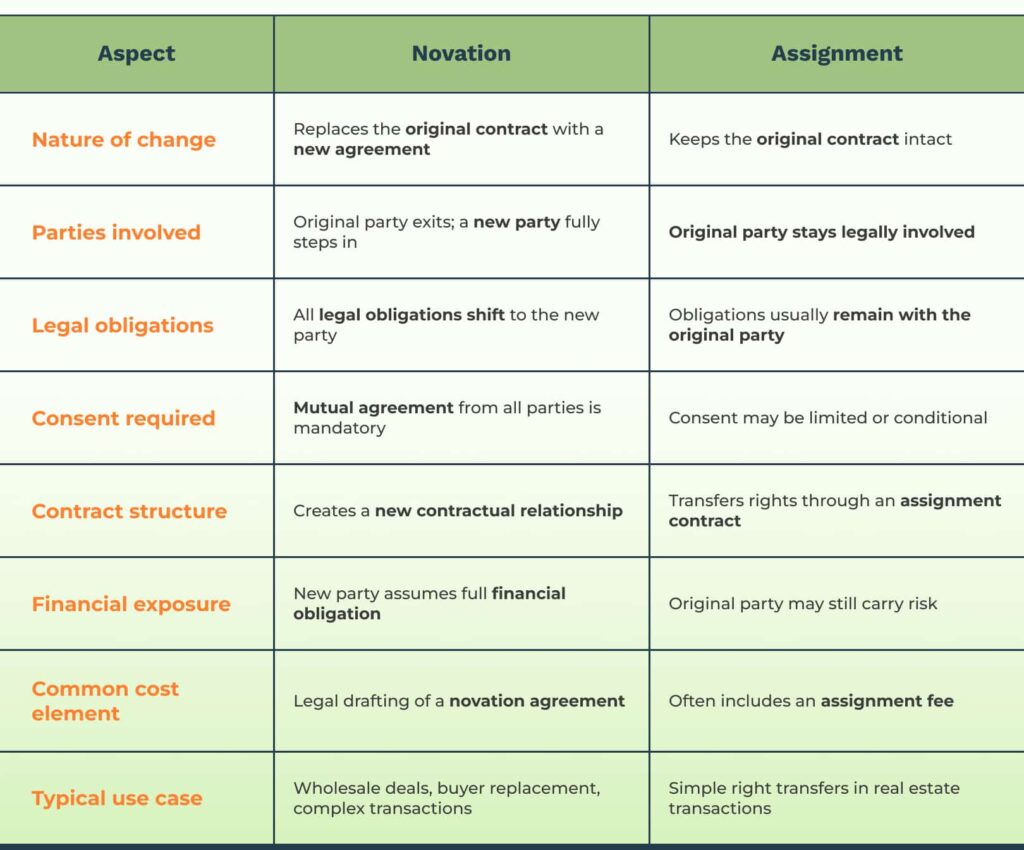
Real Estate Transactions and the Novation Process
In real estate transactions, novation is used when a deal needs to move forward, but the original structure no longer works. Instead of canceling the original contract, the parties agree to replace one party while keeping the deal alive. This is common in time‑sensitive situations where motivation, pricing, or financing has shifted.
Examples of novation in real estate
- Replacing an original buyer with a new buyer without terminating the original contract
- Adjusting lease terms in a lease agreement when a new owner or operator steps in
- Transferring financial obligations in a wholesale deal to an end buyer
In Real Estate Investing, novation is often used as a problem‑solving tool rather than a shortcut. Investors rely on it when a clean exit or reassignment isn’t possible under the existing contract terms.
How novation works in real estate investing
- Enables the transfer of rights within real estate contracts while creating a new agreement
- Used by real estate investors as a strategic approach in complex deals
- Adds flexibility in property management and ongoing lease agreements
This process allows deals to adapt without collapsing, especially when market conditions, buyers, or financial responsibilities change mid‑transaction.
Legal and Financial Aspects of Novation Agreements
A novation agreement is not just a paperwork swap; it resets legal and financial responsibility. If this part isn’t handled cleanly, problems usually show up at closing or later during disputes. Getting the structure right upfront protects all parties and keeps the transaction enforceable.
Key components of a novation contract
- Clear effective date stating when the old contract ends and the new agreement takes over
- Explicit contract terms outlining rights, obligations, and timelines
- Written mutual agreement from the original party and the new party (no assumptions or side emails)
- Precise handling of deposit amount transfers and confirmation of the final purchase price
Role of real estate attorneys and due diligence
- A real estate attorney ensures compliance with contract law and local regulations
- Novation agreements must clearly assign legal obligations to avoid future liability disputes
- Attorneys help identify gray areas like earnest money ownership, default risk, and closing responsibility
- Proper due diligence confirms the old contract can legally be replaced without violating the lender or seller terms.
When novation is done right, it creates clarity. When it’s rushed or vague, it creates risk. This section is where precision matters most.
Impact of Novation on the Real Estate Market

Novation changes how deals move through the market by shifting obligations, pricing control, and buyer profiles without restarting the entire transaction. When used correctly, it creates flexibility; when misused, it introduces risk.
How novation affects property prices and market value
- Selling price often improves because the deal can be restructured for a stronger end buyer rather than rushed to close.
- Market value stays intact since the original contract remains in play, avoiding distressed-sale signals.
- Works well in tight market conditions where inventory is low and timing matters
Fit for motivated sellers and home buyers
- Motivated sellers benefit from continuity, fewer fall-throughs, and less time back on the market.
- Home buyers get access to properties already under contract, often with clearer timelines and terms.
- End buyers can leverage strategic real estate financing without renegotiating from scratch.
Challenges in the novation process
- Disputes can arise if the roles between the original party and the new party aren’t clearly defined.
- Debt obligations must be cleanly transferred to avoid lingering financial responsibility.
- Poor documentation increases legal exposure during closing, especially in complex real estate transactions.
This section stays focused on real-world impact pricing, buyer behavior, and risk, without the theory loop.
Practical Tips for Real Estate Professionals and Investors
Novation works best when it’s treated like a structured deal, not a shortcut. The investors who use it successfully focus on execution, compliance, and clean paperwork rather than speed alone.
- Work closely with title services to confirm the original contract, liens, and closing flow before introducing a new party
- Loop in property management experts early if lease terms or tenant continuity are part of the novation strategy
- Use novation deliberately as an investment strategy in real estate wholesaling, especially when assignment is restricted or flagged
- Keep documentation airtight: novation agreement, updated contract terms, deposit amount, and purchase price must be clearly recorded
- Maintain clear contact information for all parties to avoid delays, disputes, or breakdowns during the closing process
This approach reduces risk, protects margins, and keeps deals moving without unnecessary friction.
What You Need to Know About Novation in Real Estate?

Novation isn’t just a legal concept; it’s a working tool we actively use to help real estate professionals close smarter deals in 2026. At its core, novation allows the transfer of rights and obligations from an original contract to a new party, without breaking the deal structure. When done right, it protects all sides and creates flexibility where traditional contracts fall short.
How do we help at The Land Method?
- We teach novation step‑by‑step, not the theory of how to replace an original buyer or seller while keeping the original contract intact.
- We break down real-world novation structures used in real estate transactions, wholesale deals, and creative financing.
- We focus on risk control: who holds legal obligations, how deposit amounts are handled, and how to avoid disputes between parties.
- We help real estate professionals decide when novation works better than assignment, especially in tighter market conditions.
- We guide investors on using novation to serve motivated sellers, end buyers, and property owners without violating contract law.
Why does this matter in 2026?
- More complex deals → higher need for clean transfer of obligations
- Stricter scrutiny from title companies and attorneys
- Investors need flexible tools that still hold up legally
If you understand novation properly and apply it correctly, you don’t just move contracts. You move deals forward with confidence, clarity, and control.

FAQs
Q1. What is novation in real estate, in simple terms?
A1. Novation replaces an existing contract with a new one. The original agreement ends, and a new party assumes full legal responsibility. Nothing is “assigned”; the deal is rewritten.
Q2. How is novation different from assignment?
A2. Under an assignment, the original party remains legally bound to the deal. With novation, they’re fully released. That’s the key difference most investors overlook.
Q3. When does novation make sense in real estate deals?
A3. Novation works best when deal terms need flexibility, price changes, a new buyer, or shifting obligations. It’s common in creative financing and higher‑value transactions.
Q4. Is novation legally risky?
A4. It can be if done casually. Every party must agree in writing, and contract terms must be crystal clear. That’s why experienced investors treat novation as a legal process, not a shortcut.

Ginis Garcia is a seasoned real estate investor with over 14 years of experience helping both new and experienced investors achieve their goals in the housing and land markets. He started doing deals here and there in 2008. In 2011, He started working for a major real estate investor. He got his real estate license in 2012.