

Is land a long‑term asset? The short answer from the data is ‘yes,’ and the numbers tell a far more compelling story than opinion alone.
Across the United States, land values have risen steadily for decades. Is land a long‑term asset? The short answer from the data is ‘yes,’ and the numbers tell a far more compelling story than opinion alone.
Looking at national land value trends helps explain why land consistently outperforms many short‑term assets over time.
- According to USDA farmland data, the average U.S. farm real estate value reached ~$4,350 per acre in 2025, marking a 4.3% year‑over‑year increase.
- Average cropland values rose to approximately $5,830 per acre during the same period.
- Since 2020, cropland values have increased by nearly 37%, despite rising interest rates and fluctuating commodity prices.
That kind of performance isn’t typical of short‑term assets like savings accounts or marketable securities, which are intended to be liquid or sold within a year. Instead, land sits by design in the realm of long‑term assets. In accounting terms, land is classified as a tangible asset and recorded under non‑current assets on the balance sheet because it’s not expected to be sold quickly or used up within a short period of time. This is a core difference from short‑term assets such as accounts receivable, inventory, or cash equivalents.
Land sits alongside other physical assets in financial reporting, not just because it’s physical, but because it doesn’t depreciate like equipment or leasehold improvements and, historically, has appreciated over decades. This distinction arises because land investment differs from owning intangible assets, which cannot be touched but may include intellectual property or goodwill.
At The Land Method, we train investors to look at land not as a quick flip or a gamble, but as a strategic long‑term investment. Our approach combines real data with grounded due diligence so that land investment decisions reflect real market-value trends, future development possibilities, and long‑term financial planning rather than short‑term speculation.
What Makes Land a Long‑Term Asset?
Understanding Asset Classification
From an accounting point of view, land sits under non‑current assets because it’s not something people usually buy to sell quickly. It’s a tangible asset meant to be held over a long period of time, not flipped like a short‑term investment or treated like a cash equivalent.
- Land does not depreciate the way buildings or leasehold improvements do.
- The purchase price stays on the books as its book value, even if the market value changes.
- Because land is a physical asset with a limited supply, it doesn’t lose usefulness over time.
What actually affects land value isn’t wear and tear; it’s what happens around it.
- Zoning laws and land-use rules determine what the land can realistically be used for.
- Development plans, new roads, or nearby commercial growth can completely change demand.
- Raw land, vacant land, and agricultural land often gain value slowly, not overnight.
This is why land is usually treated as a long‑term investment rather than a quick exit. It’s held with patience, based on location, future use, and long‑term demand rather than short‑term market movement.
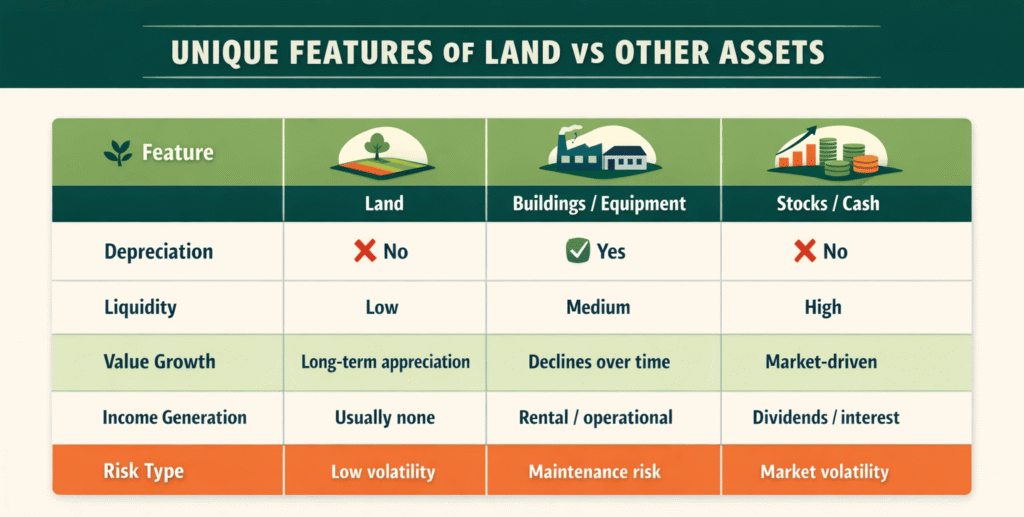
Unique Characteristics of Land
One of the most distinguishing features of land is that it does not depreciate. While physical structures like buildings or equipment lose value due to wear and tear, land typically retains its intrinsic worth over time.
In fact, land often appreciates in value, especially in areas experiencing economic growth, infrastructure development, or increased demand. This appreciation potential makes it an attractive long-term investment option.
Additionally, land use regulations and zoning laws play a crucial role in determining its value. Changes in zoning, from residential to commercial, for example, can significantly increase land value. Conversely, restrictions or regulatory changes may impact its usability and valuation.
Why Land Is a Valuable Asset for Investment Portfolios?
Revenue Generation and Growth Potential
Land plays a different role in an investment portfolio compared to stocks, mutual funds, or other real estate investments. It’s less about quick returns and more about stability, positioning, and long‑term upside.
- Land ownership contributes to long‑term value without relying on ongoing revenue generation.
- Unlike rental properties, land doesn’t depend on tenants, operating income, or daily business operations.
- Many investors use land to balance risk when other assets are exposed to market volatility, especially in the stock market.
From a financial standpoint, land strengthens overall asset structure.
- Land appears on financial statements as a non‑current asset, supporting a stronger long‑term financial position.
- It does not affect the income statement through depreciation expense, unlike buildings or improvements.
- For business owners, land can offset liabilities such as accounts payable while improving balance‑sheet asset values.
Land in Financial Statements
When land shows up in financial statements, it’s treated very differently from most other assets. This often gets overlooked, but it matters for both investors and business owners.
- Land is recorded on a company’s balance sheet as a non‑current asset within the asset account.
- It is not classified as a cash equivalent and does not fall under Current Assets because it isn’t meant for short‑term liquidity.
- Unlike inventory or accounts receivable, land is held for its long life span and long‑term value.
One key distinction is depreciation.
- Land does not follow a depreciation schedule and does not create a depreciation expense on the income statement.
- Buildings, leasehold improvements, and manufacturing facilities depreciate; land does not.
- This keeps the land’s book value stable over time, even if its market value changes.
From a business and investment perspective, this has practical effects.
- Land can strengthen a company’s financial position without adding pressure to operating income.
- It helps balance liabilities like accounts payable while supporting long‑term asset values.
- Because land doesn’t impact cash flow the same way other assets do, it often improves liquidity ratios and overall balance‑sheet structure.
This accounting treatment is one of the reasons land continues to be viewed as a steady, long‑term asset rather than a short‑term holding.
How to Evaluate the Value of Land?

Market Conditions and Physical Form
Land value isn’t just about recent sales. It’s about what the land can actually be used for and how realistic that use is.
- Market conditions matter, but context matters more. A rising market won’t help much if demand in that specific area is weak.
- Zoning regulations and land-use rules often determine value more than anything else. If the zoning doesn’t support development, growth potential stays limited.
- The land’s physical form plays a role, too, as access, shape, soil quality, and available utilities can either support or restrict future use.
- In some cases, natural resources or mineral rights can increase land value, but only if they’re legally usable.
Thorough Research for Investment Decisions
- The buyers should consider not just today’s market value for the purchase price, but also how long they may need to hold the land.
- Vacant land and raw land often take time to appreciate and aren’t always easy to sell quickly.
- Ignoring zoning limits, local demand, or market volatility can turn land into a high‑risk investment fast.
The Role of Land in Business Operations
Land Ownership Benefits for Small Businesses
For businesses, land is less about short‑term returns and more about control, stability, and long‑term positioning.
- Land ownership provides businesses with a fixed base for operations, such as manufacturing facilities, storage, parking lots, or future real estate development.
- Unlike leased property, owning land reduces long‑term dependency on rising rents and shifting lease terms.
- Over time, land can strengthen a company’s financial position as asset values increase while fixed costs remain stable.
From an accounting and cash‑flow perspective, land plays a quieter but important role.
- The company records land on its balance sheet as a long-term asset and does not generate depreciation expense.
- This helps protect operating income, especially compared to assets that steadily lose value.
- For small business owners, land can help balance liabilities like accounts payable without draining working capital.
Land also offers flexibility that other assets don’t.
- Businesses can hold land unused, improve it gradually, or align it with future expansion plans.
- Even when land isn’t actively generating revenue, it can still support long‑term value and stability.
- This makes land useful not just as an operating asset, but as a strategic one.
Asset Management and Liquidity Ratios
It’s also important to differentiate land from intangible assets such as intellectual property, trademarks, or patents. While intangible assets derive value from rights and innovation, land is a physical asset with measurable market value and long-term usability.
Land plays a significant role in evaluating a company’s overall asset structure. Although it does not directly contribute to short-term liquidity ratios, its value is crucial for long-term financial planning, investment decisions, and the management of working capital. Businesses often use land as collateral to secure financing, making it an essential component of strategic asset management.
Maximizing the Benefits of Land Investments with The Land Method
At The Land Method, we work with investors who are intentionally allocating capital into land as a long‑term investment, not as a substitute for short‑term assets or cash equivalents. Our team builds our approach around asset classification, risk control, and realistic holding timelines.
When we assess a land investment, we look beyond surface‑level market value.
- We compare the purchase price to the present value based on zoning laws, intended use, and nearby development plans, rather than on speculative future pricing.
- We evaluate whether we should report land as a non‑current asset in the financial statements or whether liquidity constraints make it unsuitable for the investor’s working capital needs.
- We identify when raw land, vacant land, or agricultural land aligns better with a client’s investment portfolio than marketable securities or mutual funds.
A major mistake we see is investors treating land like other real estate investments.
- Land is a physical asset, not an income‑producing one, and it doesn’t behave like rental property or manufacturing facilities.
- It does not generate operating income or appear on the income statement through depreciation expense, which changes how it impacts the overall financial position.
- Land should be evaluated as a valuable asset held for a defined period, not as something positioned for immediate sale.
How The Land Method Helps You Choose Land That Builds Stability
At The Land Method, we don’t sell land as an idea. We help clients decide whether land belongs in their asset category at all, and, if it does, which land actually makes sense given accounting standards, intended use, and realistic growth potential.
We focus heavily on risk before upside.
- We flag zoning regulations that restrict land use or limit future development plans.
- We assess exposure to market volatility, especially in areas where a single industry or development project ties the demand.
- We help clients avoid over‑allocating capital into land that weakens liquidity ratios or creates pressure on accounts payable.
Where land fits best is as a stabilizer.
- It strengthens asset values on a company’s balance sheet without increasing depreciation schedules.
- It provides long‑term value that differs from that of the stock market or savings accounts.
- When chosen correctly, land ownership supports long‑term financial stability rather than short‑term performance.

FAQs
Q1. Is land a long-term asset?
A1. Yes, land is considered a long-term (non-current) asset because it is held for extended periods and not intended for immediate resale. Businesses and investors typically use land for operations, development, or long-term investment, and it often appreciates in value over time.
Q2. Is owning land considered an asset?
A2. Absolutely. Owning land is a valuable asset because it has measurable economic value and can generate future benefits. Businesses can use it for operations, individuals can lease it for income, or they can sell it at a higher price, making it a key part of an individual’s or company’s net worth.
Q3. What type of account is land?
A3. In accounting, land is recorded as a fixed asset (non-current asset) account on the balance sheet. It falls under tangible assets and is unique because it does not depreciate, unlike buildings or equipment. It typically lists at its original purchase cost unless revaluation is applied.
Q4. How does The Land Method help reduce risk when investing in land?
A4. At The Land Method, we work with clients who want clarity before committing capital. Through our programs, we help investors evaluate land based on zoning laws, intended use, holding timelines, and realistic exit options. We focus on aligning purchase price with present value and ensuring the land fits the client’s broader investment portfolio, rather than becoming a liquidity burden or a speculative bet.

Ginis Garcia is a seasoned real estate investor with over 14 years of experience helping both new and experienced investors achieve their goals in the housing and land markets.